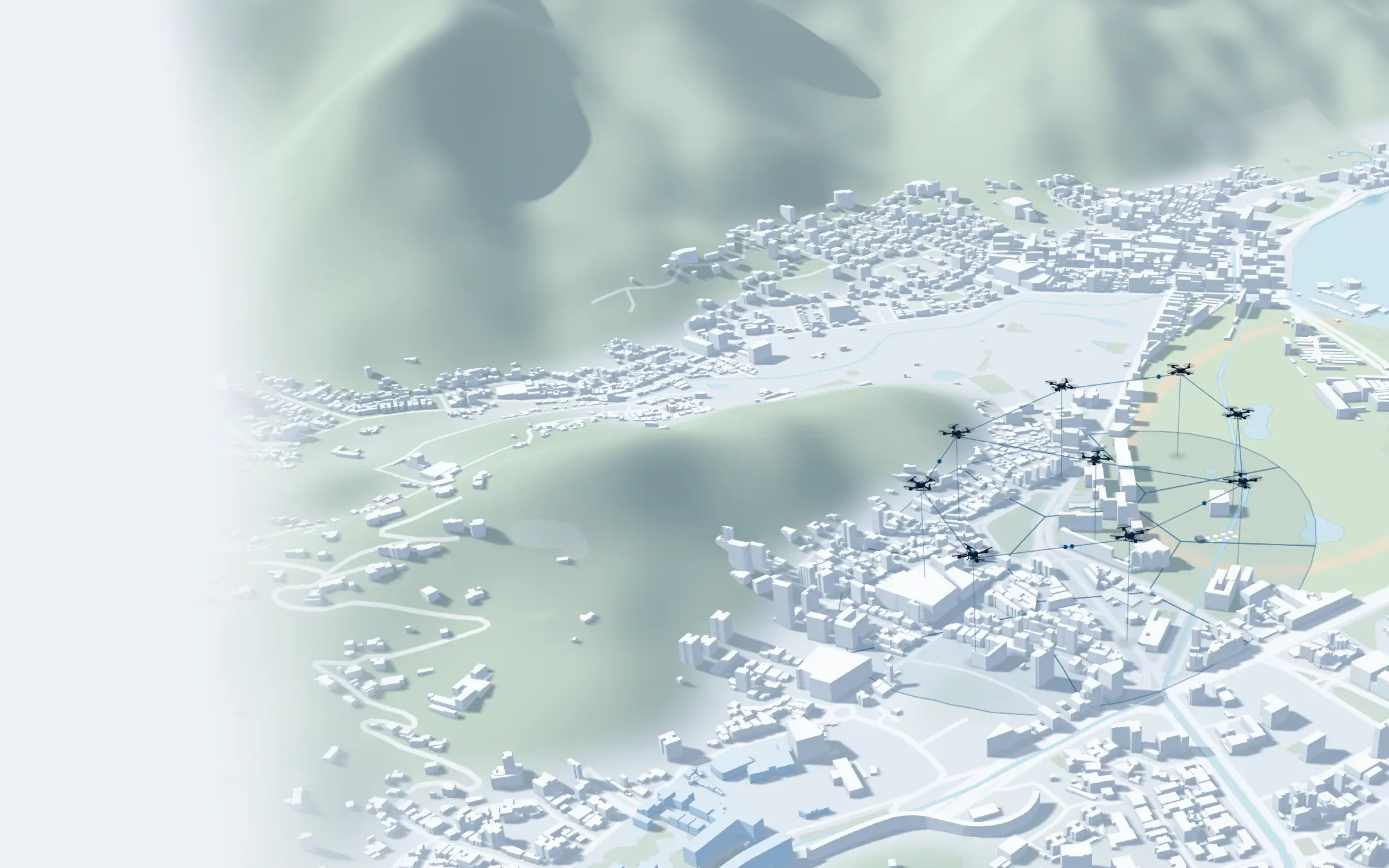
Gávea in three dimensions, viewed from the southwest: the PUC-Rio campus in blue, drones dividing an area of streets among themselves, the Lagoa lagoon and, in the background, the Corcovado massif.
Gávea · Rio de Janeiro · © OpenStreetMap Simulation · illustrative scenario

If a drone leaves, the mission continues.

BeSwarm develops the software that enables multiple drones to operate as a single team: a swarm. The drones divide the mission among themselves, without depending on a central control station, and redistribute the work whenever one of them leaves to recharge or fails. Advanced Brazilian technology, built on leading-edge research.

Simulation: click on a drone to remove it from the mission

Origin

Built within academia

BeSwarm was founded by former members of LAC, a laboratory of the Department of Informatics at PUC-Rio, a graduate program holding the highest rating awarded by CAPES. In the highlighted building, RDC, the swarm algorithms are written and tested in simulation before going into the field.

  • Research with the aerospace industry. The laboratory has a track record of projects with Boeing, Sikorsky, Bell Helicopters and Microsoft.
  • Continuous funding since 2021. LAC has received successive rounds of funding from international agencies, in addition to support from several Brazilian institutions.

How it works · 1 of 3

The drones divide the mission among themselves

Each drone communicates with its neighbors over a network of its own, which operates with or without communications infrastructure. Together they share out the work, in this case an area of streets and squares to be covered. No one needs to assign tasks to them.

Coverage100%Airborne9

How it works · 2 of 3

If a drone leaves, or if the base loses signal, the mission continues

When a battery runs low, the drone returns to base on its own and its neighbors take over its share of the work. If the link with the ground station is lost, the drones remain coordinated among themselves. Critical decisions remain with your team.

Coverage100%Baseconnected

How it works · 3 of 3

Two swarms meet and become one

When two groups come within radio range of each other, they begin to treat one another as neighbors and redistribute the work together. To reinforce an operation, it is enough to send more drones to the area. If one group is called elsewhere, the drones that remain close the gap.

Swarms2Drones9

Where the swarm can operate · 1 of 5

Forest fires

Between the water source and the fire front, the drones can form a continuous circuit. Each one adjusts its pace to the drone ahead and the drone behind, and the water drops arrive at regular intervals, even when one of them leaves to recharge.

Active fires5Water drops0

Where the swarm can operate · 2 of 5

Search operations

A line of drones sweeps the hillside from one side to the other, each one assigned to its own strip. If one leaves to recharge, its neighbors close the line and no stretch is left unobserved.

Strip covered100%Airborne9

Where the swarm can operate · 3 of 5

Delivery hub

At a vertiport, drones land and take off throughout the day. The arrival queue, the charging positions and the departures are organized by the drones themselves, without a controller scheduling each flight.

Deliveries0In queue5

Where the swarm can operate · 4 of 5

Agriculture

The swarm divides the field into strips and each drone covers its own, for mapping or spraying. If one leaves to recharge, the remaining strips are redistributed among the drones that stay.

Field covered50%Airborne6

Where the swarm can operate · 5 of 5

Support for remote locations

An air bridge between the onshore base and the platform carries parts, samples and equipment in short, successive flights. Far from the coast there are no cell towers: the network is the one the drones form among themselves.

Trips0En route8

Platform · software

BeSwarmOS

The core of the system. It runs on board each drone and makes the group act as one: it divides tasks, plans routes and revises the plan whenever an aircraft leaves. The protocol your team validates in the simulator is the same one that flies on board.

  • 3 to hundredsaircraft per swarm
  • NetworkMesh/Ad-Hoc/LTE/Wi-Fi
Discover BeSwarmOS

Product: BeEyes

One operator, multiple points of view

In urban operations or along borders, ground teams see little beyond their own position, or rely on drones operated individually. BeEyes keeps several small drones covering the sector at the same time, providing more imagery and redundancy.

Artificial intelligence highlights what deserves attention. The decision always rests with the team.

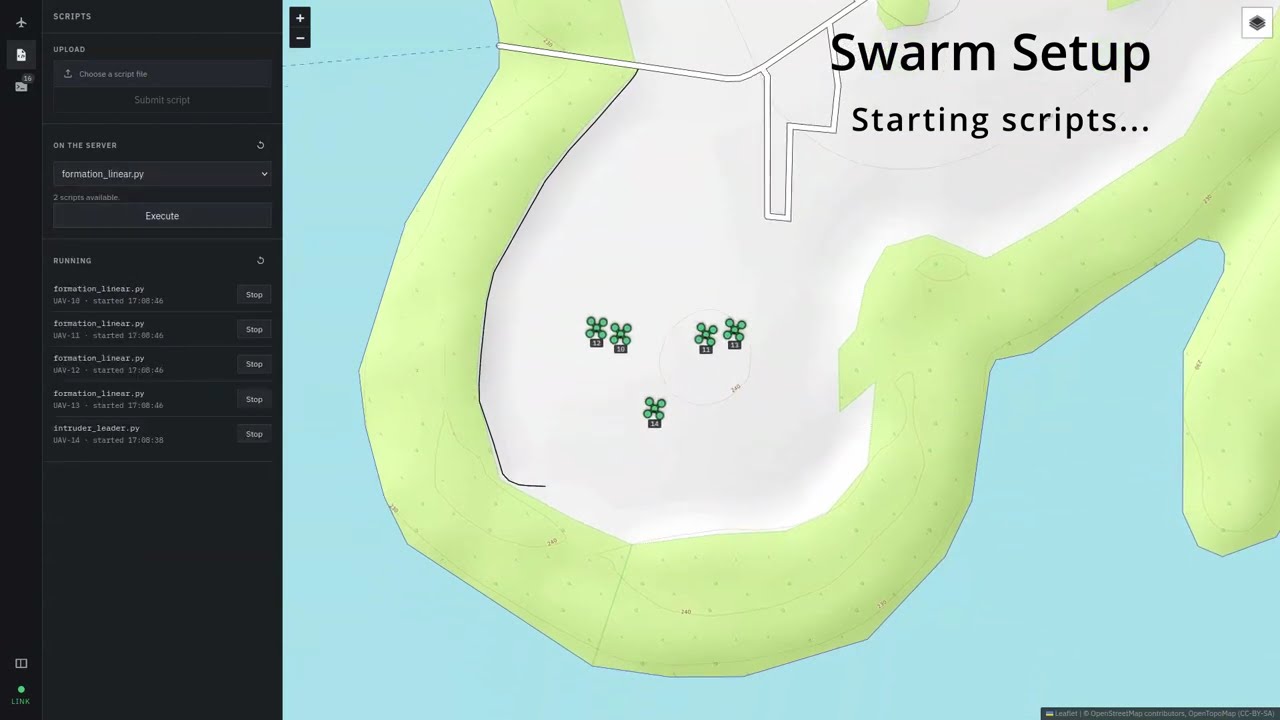
Fifty-five minutes of a real mission, condensed. The BeSwarm ground station sends the mission to the swarm and tracks each drone.
Discover BeEyes

How we get started with you

From controlled testing to operations

No team goes straight from zero to the field. Deployment advances in stages, and each stage begins only after the previous one has been evaluated together with your team.

  1. Proof of conceptSimulation and controlled tests to integrate the drones with your command station.
  2. Pilot in a controlled environmentYour team trains in a simulated scenario, still without operational use.
  3. Assisted operationUse in real situations, with a limited scope and an evaluation protocol.
  4. Integration into the operations centerThe swarm becomes part of the routine, with formalized doctrine and records.